

The movement of live animals by ocean carriage is a highly specialized logistics niche, requiring a wide range of supply chain expertise.
It might be said that Noah was the first to ponder the logistics of moving livestock by ocean. Since antiquity men and women have faced the challenge of moving animals, it’s an age-old balancing act. Today specialized exporters, forwarders, ports, and carriers have taken up this challenge. Last year the U.S. exported 238,700 head of cattle to countries around the world, and this January and February alone the U.S. has already transported 64,967 head of dairy and beef cattle.
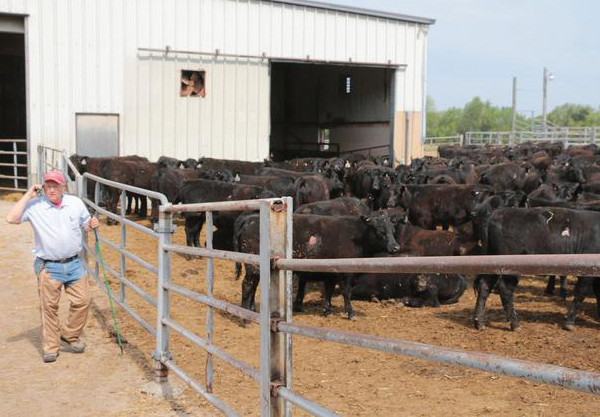
Preparing and Transporting Livestock
C. Gordon Thornhill Jr. has been exporting livestock for over 30-years as president of T.K. Exports, Inc. He started the company in 1982 after five years with the Virginia Department of Agriculture. His firm has expertise in not only sourcing and preparing cattle for shipment, but also in transporting them and arranging for their initial care and integration into their new herds.

“This business is a business that requires a specialty knowledge”, Gordon said, “Being a cattle breeder, being a cattle buyer or being a transportation specialist to me doesn’t cut it in this business; you’ve got to be a jack of many trades.” T.K. Exports has shipped everything from hogs to horses, but lately, the business has gravitated toward beef cattle. The firm has active markets in South America, Southeast Asia, Russia, and Eastern Europe.
“Over the years I’d say we have sent animals to around 50 countries. In some of these markets we’ve sent 50 to 100,000 breeding females to perpetuate herds.” When talking about target markets, Russia and Kazakhstan have large country-wide programs to increase their herds which have waned since the breakup of the Soviet Union. In Kazakhstan, for example, Gordon noted, “They went from something like 30 to 40 million populations of beef animals and dairy animals down to less than 10 million animals. They actually have World Bank loans and a huge undertaking in what they are trying to do. If you look at a map, they are right in between China and Russia, which they see as an end product for their meat. They are trying to produce their own meat as opposed to buying it from us or Canada or Europe.
Shipping to Kazakhstan has its own set of logistic challenges, Gordon noted. “The challenge here is how do we deliver directly to the farm? Again looking at the map, Kazakhstan has no seaport. What we’re doing is crossing over two countries, we’re going to Russia and then we’re trucking to Kazakhstan. The challenge for me is that I’m in charge of all of it. The shipments are based on D.A.P. Delivery at Point as opposed to CIF, which most people deal with. We deal with the challenges of transporting over another country which involves more bio-security because you have to meet the health requirements of that country and then you have to line up the truck transportation which in this case is something like 2,000 miles over Russia. You have to have various permits; you have to have CMRs, which is like an interstate permit here in the states. You have to have places cleared by the government so that you can offload the animals, let them drink, then reload them for transport.”
Within the Russian market, Gordon explained, “Russia probably has demand for 100 million head; they have less than 25 million. There is a demand there for the future to improve the diets in Russia.”
Specialized transportation is the name of the game for T.K. Exports, from the ports they choose to the specialty carriers like Livestock Express, which move their cattle. By the nature of this business T.K. Exports owns the animals they export from the time of purchase until delivery and integration into the import herd. “It’s not like delivering a container to some port. Years ago we delivered animals to some port and wiped our hands of it. Now we have advanced teams that go in and make sure they are ready to receive the animals and then after the animals arrive, we have another team that goes in to acclimate the animals to the situation.”
US Ports Play a Significant Role in Exporting Livestock
T.K. Exports moves ten or more shipments per year through the port of Wilmington, Delaware. Wilmington is the leading seaport in the U.S. for cattle export. They have six open berths with a depth alongside of 35 to 38 feet.
John Haroldson, director of Commercial Services for GT USA, the port’s management firm, said, “We simply provide a berth for the ship to tie up, but the receiving of the feed/hay and the loading of the cattle is handled by 2 logistic partners on behalf of shippers.” Wilmington provides year-round covered storage for hay, feed, and bedding. They have 33 acres of staging area for transferring livestock via two loading platforms with multiple side-port capabilities. GT USA noted Wilmington entered the livestock trade in 1987 loading live cattle to Venezuela, Egypt, and the Canary Islands. They are members of the Livestock Exporters Association (L.E.A.).

In the Pacific North West (PNW), Olympia, Washington performs a similar role in the movement of live animals to Asia. Len Faucher, the marine terminal director for the Port, summed it up as follows, “The Port of Olympia’s success with livestock is a great example of what makes this port unique and special. The teamwork between labor, management, maintenance, stevedores, agents, USDA, Schorno’s Farm, feed suppliers, trucking companies, and all the other stakeholders involved is collaborative, supportive, and driven.” Over the past four years, the port has handled five shipments to Vietnam. When asked about future export destinations, Faucher said, “We have discussed a few other countries, but to date, all five cattle shipments have moved to Vietnam as part of their glass of milk per child per day program.”
Moving live animals always requires a unique logistical plan as Len explains, “The biggest challenge remains in properly scheduling every aspect to load these vessels, making sure the humane treatment of the cattle is the number one priority. This takes great coordination prior to the loading, a thorough pre-op meeting, and the ability to think ahead and contingency plans for situations that do not go as planned.” Faucher recalls for example, “The port’s last cattle-loading was completed during a 2-foot snowstorm. This does not happen often in the PNW. The determination of our team to get the job done was seen in full force as everyone took to the challenge and completed the loading; all to make sure the cargo was safely loaded and shipped.” The port is hoping the livestock market will grow as more countries take advantage of the higher producing dairy cattle we breed in the U.S. “This market could help with nourishment needs across the world,” Faucher said.
Livestock is loaded from truck to ship by a unique connecting ramp that was built and is maintained by the port. As such, no hooves touch the dock in the loading process. The Port of Olympia is, in their own words, a unique niche port ready to handle bulk, breakbulk, cattle and heavy lift cargos. Their new slogan is “Succeed with us, Choose Olympia!” They are also members of the Livestock Exporters Association and hope to engage with other L.E.A. members at the July annual meeting to be held in Greenbelt, Maryland.
Follow us on social media: