
A Modulift spreader beam was used beneath the hook of the largest mobile crane manufactured in serial production in the world, at the Turcot Interchange, a three-level stack freeway project in Quebec, Canada.
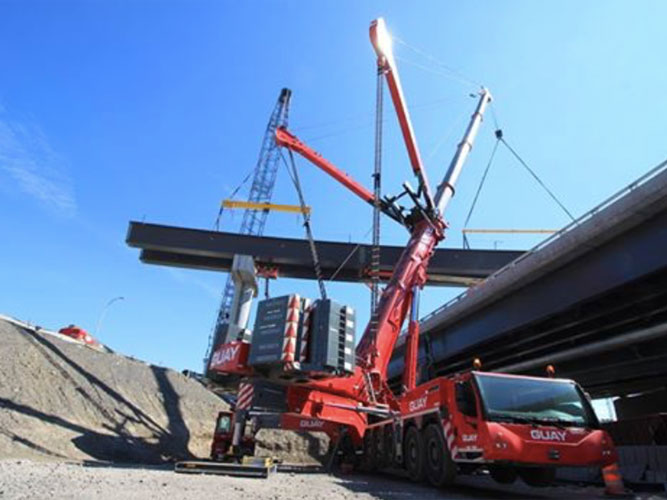
The Turcot Interchange is a hub for road traffic in the Montréal area, interconnecting highways 15, 20 and 720, in addition to facilitating access to the Champlain Bridge. It is also an essential road link between Montreal-Pierre-Elliott Trudeau airport and downtown Montréal. A crucial phase of the project was installation of two girders, weighing 200,000 lbs. apiece.
The LTM 11200-9.1, which worked at a 95 ft. radius, combined with a 300t capacity Sany SCC8300 crawler crane, but not in tandem lift, as such. Below the hook of the crawler crane a custom beam lifted the second girder and, once connection to the other one was complete, both cranes could release the load simultaneously. Synthetic slings completed the rigs on both cranes.

Wolfgang Beringer, sales promotion at Liebherr-Werk Ehingen GmbH, the crane’s manufacturer, said: “The LTM 11200-9.1 is the largest, strongest, telescopic mobile crane worldwide, which is manufactured in serial production. The LTM 11200-9.1 was launched at Bauma Munich in 2007. In 2014, we celebrated delivery of the 50th unit, at which point the cranes were already in use all over the world. The LTM 11200-9.1 was delivered to Guay Cranes in 2011.”
Beringer explained that the main advantage of a telescopic boom crane versus a lattice boom crane is set-up time, as the lattice sections have to be bolted on the ground. This requires more space compared to a telescopic crane. The transportation volume of a lattice boom crane is also bigger, he added.
The Turcot Interchange, Quebec’s largest and third busiest, was built in 1967 and the structures were nearing the end of their useful life. The project continues.
Follow us on social media: