
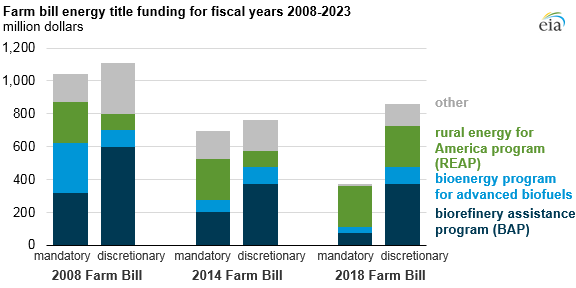
On December 20, 2018, the Agricultural Improvement Act of 2018 (2018 Farm Bill) was signed into law, continuing federal support to a number of renewable electricity and bioenergy-related programs. Authorizations in the 2018 Farm Bill cover fiscal years (FY) 2019 through 2023, during which time energy programs will receive $375 million in mandatory funding, with up to an additional $860 million in discretionary funding. These spending levels represent a 46% decrease in mandatory funding and a 12% increase in discretionary funding compared with the 2014 Farm Bill. Even though discretionary spending increased, discretionary federal support is inherently uncertain because this funding must be authorized by Congress in future appropriations bills.
Title IX federal subsidies are provided to eligible recipients in the form of project grants, guaranteed loans, and direct payments. The most common form of assistance is a USDA-guaranteed loan, where the USDA assumes the responsibility for the amount of the loan in case of default. The share of USDA-guaranteed loans under Title IX programs more than doubled during the past four years, from approximately 40% during FY 2009–2013 to more than 80% during FY 2014–2018.
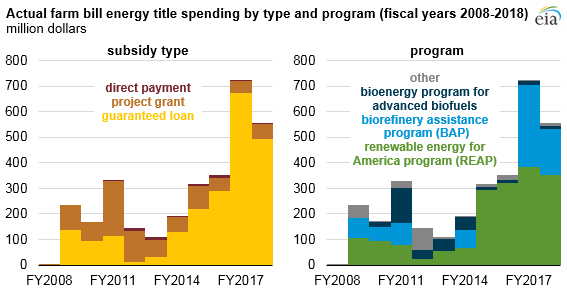
The Biorefinery Assistance Program (BAP) and the Biorefinery Program for Advanced Biofuels programs account for much of the rest of Title IX authorizations, or approximately 30% of mandatory and 55% of discretionary funding. Through BAP, USDA provides loan guarantees up to 80% of total eligible project costs up to $250 million for the construction of advanced biofuel facilities and other qualifying technologies. The Bioenergy Program for Advanced Biofuels provides cash payments to biorefineries to encourage the production of advanced biofuel. Mandatory funding for both programs was reduced in the 2018 Farm Bill.
Other Title IX programs generally receive smaller levels of government support or are more dependent on discretionary spending. These programs involve the growth of biomass energy crops, biodiesel education, bio-based product labeling, and other energy-related issues. Overall, spending on Title IX programs will represent a small fraction of the overall farm bill, which was valued at $428 billion during FY 2019–2023 by the Congressional Budget Office.
Principal contributor: Steve Hanson
Follow us on social media: