

Windpower component shipments have boosted breakbulk totals for Canadian ports.
The global breakbulk market has witnessed a surge in shipments of wind power components in recent years, a trend that has also gathered momentum in Canada. Transportation providers on both water and land have been engaged in shipping components manufactured notably in Europe and domestic sources. And there is no sign of weakening demand for the immediate future, although sometimes opposition surfaces from local residents impacted by a wind power project.
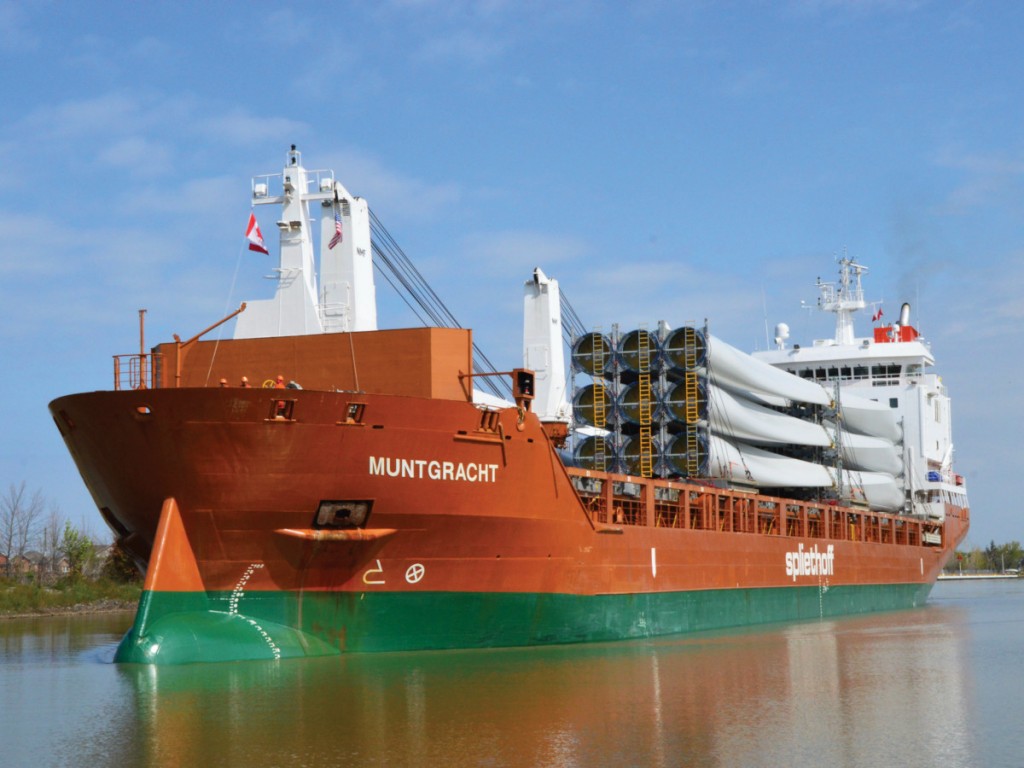
Indeed, Canada in 2018 continued to show strong and stable growth in this niche sector, reports the Canadian Wind Energy Association (CanWea). It finished the year with close to 13,000 megawatts of capacity, enough to power some 3.3 million homes or 6% of electricity demand. National installed capacity has doubled since 2012.
Robert Hornung, the Association’s president, asserts, “Each year, the wind energy industry provides more clean and low-cost electricity to Canadians and increases its contributions to a modern and reliable electricity grid. Wind is a success story across the country – helping to meet electricity demand in a way that is consistent with Canada’s climate ambitions and that benefits landowners, rural and indigenous communities, and the economy.”
Last year saw the completion of six projects that added 566 MW of new installed capacity, with Ontario and Quebec accounting for nearly 9,000 MW.
Canada is home to the world’s ninth largest wind generating fleet. There are today some 300 wind farms operating from coast to coast, comprising 6,600 turbines, including projects in two of the three northern territories. Among Canadian provinces, the large bulk of capacity is currently located in Ontario (40%), Quebec (30%) and Alberta (12%).
For 2019, CanWea anticipates 1,000 MW of new wind energy projects commissioned in Alberta, Ontario and Saskatchewan.
Positive Outlook on St. Lawrence Seaway
In an interview, Bruce Hodgson, director of market development for the St. Lawrence Seaway Management Corporation, offered an optimistic outlook. “Project cargoes are important to HWY H2O. The Great Lakes St. Lawrence System competes vigorously with other gateways such as the East Coast of the US and the US Gulf. Our ports, carriers and other supply chain stakeholders work collaboratively to insure the seamless delivery. It is a team endeavor!
“We handle a wide variety of cargoes, from wind turbines and blades to modules destined to the oilsands in Western Canada. The volume of project cargo moving through HWY H2O for the 2018/2019 season was at a similar level to the previous year at 400,000 metric tons. This traffic was destined to a number of ports including Toledo, Cleveland, Thunder Bay, Duluth, and Detroit. We also saw the export of locally manufactured wind blades from Duluth to Europe.”
“Looking forward,” Hodgson stated, “we see a robust year ahead, with wind cargoes forecast to be up and a number of infrastructure projects coming on line. We will be aggressively continuing our sales and promotion initiatives in the project cargo/over-dimensional market, working with existing and new carriers explaining the ease of transiting our system.”
Also optimistic was Tim Heney, CEO of the Port of Thunder Bay on the tip of Lake Superior which in recent years has developed a growing business in project and dimensional cargoes. He said he looked forward to another strong Seaway season in 2019 in the project and breakbulk business at Keefer Terminal.
The season began this spring with a return of steel and rail shipments destined for western Canada.
“Steel shipments continue to increase and diversify with beams, rail and pipe and we are also looking at coil shipments for this season,” Heney said, “Other regular cargoes include wind turbines, electrical transformers and pressure vessels.”
Otherwise, he added, “The big story is the construction of our new rail yard and heated warehouse building in partnership with the National Trade Corridors Fund and the Northern Ontario Heritage Fund. This project will increase cargo handling capacity and efficiency.”
Valleyfield’s Arctic Cargo Horizons
Similarly, upbeat was the Port of Valleyfield, on the St. Lawrence Seaway near Montreal.
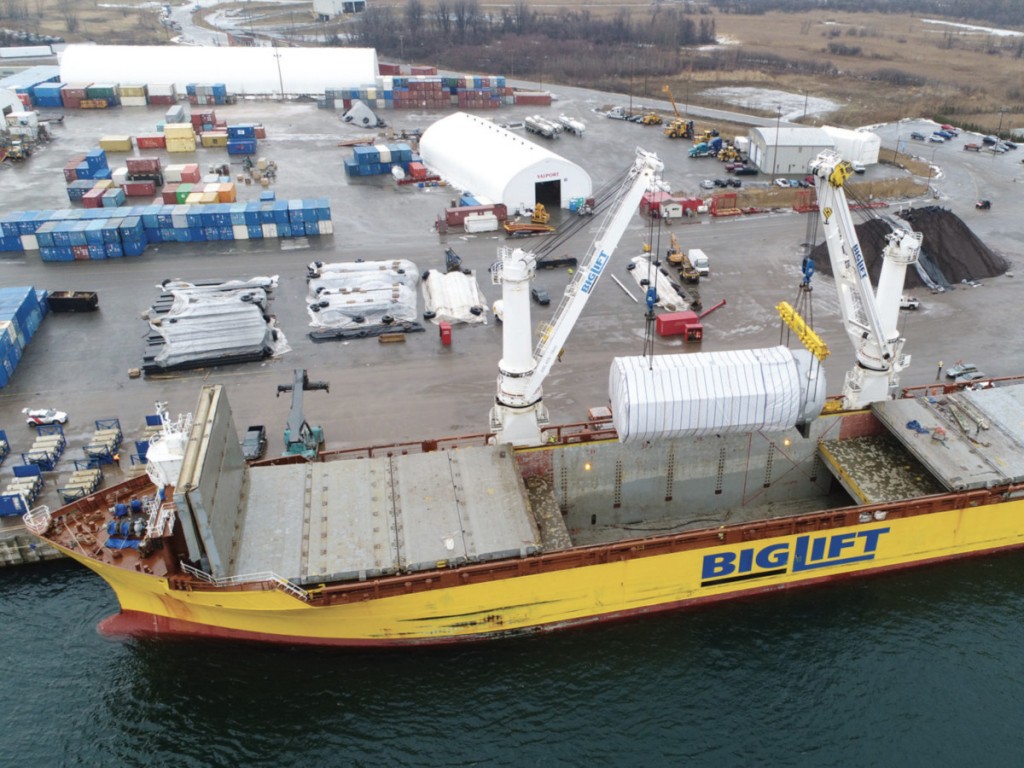
“We are looking forward to another busy season in 2019,” said Jean-Philippe Paquin, the port’s general manager. “Positioned mainly as a project cargo and regional bulk port, we continue to see a growing volumes of domestic Arctic cargo. Most notably NEAS, a leader in Arctic service, will increase its ship capacity in 2019 and is expected to have a banner year. Capital investment projects at Baffinland Iron Mine is also fueling growth for Desgagnés Transarctik.
“International breakbulk cargo is showing healthy growth on Spliethoff’s CEE service, in addition to the new monthly service from Compass Logistics, inaugurated in September 2018, linking Rotterdam and Valleyfield. This added capacity on the growing Canada-Europe trade lane should allow us to further increase our international breakbulk traffic.”
“The growth in project cargo is also pushing port limits.” Paquin indicated. “The new bulk terminal built in 2018 is already committed to bulk cargo users, and additional space is needed to accommodate the growing breakbulk volumes. The port has already started work to expand lay down area for breakbulk, adding approximately 215,000 square feet of space. Later this spring, work will also begin on our gate expansion project. We will be doubling gate capacity to accommodate traffic from our various users, adding gates and an automated check-in process for breakbulk deliveries, as well as a second scale to accelerate bulk cargo truck movements.”
Amherst Island wind energy project
Among recent major wind farm undertakings in Canada, one worth highlighting involved Ontario-based tug and barge operator McKeil Marine in the $272 million Amherst Island wind energy project that was completed and reached an operational stage last summer. The project was established in response to the Government of Ontario’s commitment to developing renewable electricity. A total of 26 wind turbines were installed on Amherst Island, located six miles west of Kingston on Lake Ontario.
“All materials, supplies and workers were transported from an assembled dock near Millhaven ON,” noted Jayson Stansfield, Manager Commercial. “McKeil was contracted to supply a complement of tugs, barges and workboats. McKeil’s clients, Algonquin Power and Pennecon Limited, felt the firm was right after seeing our vessels in action on the Pave-Al project at Billy Bishop Airport on Toronto Island.”
However, this was one of those projects that sparked considerable controversy during a decade-long battle that saw 350 of the island’s 420 residents oppose it. Nevertheless, 17 landowners are today “hosting” the 26 turbines.
Follow us on social media: