
Detailed contingency planning is an essential feature of any project move and having the right team in place is the key.
For project cargo specialists, detailed contingency planning is a basic tool of the trade. Figuring out all the possible twists and turns — both literal and figurative— is what sets the successful project cargo personnel apart from the rest. But occasionally, something comes up that has even the most experienced scratching his or her head.
Two years back, Logistics Plus was tasked with planning and executing the transport of 13 giant brewery tanks, from the port of Izmir, Turkey, where they arrived by ship from Germany. They took the tanks by road to a Tuborg factory near the center of Turkey’s third largest city. Each tank weighed between 24 and 31 metric tons, was at least 20 meters long and more than five meters high.
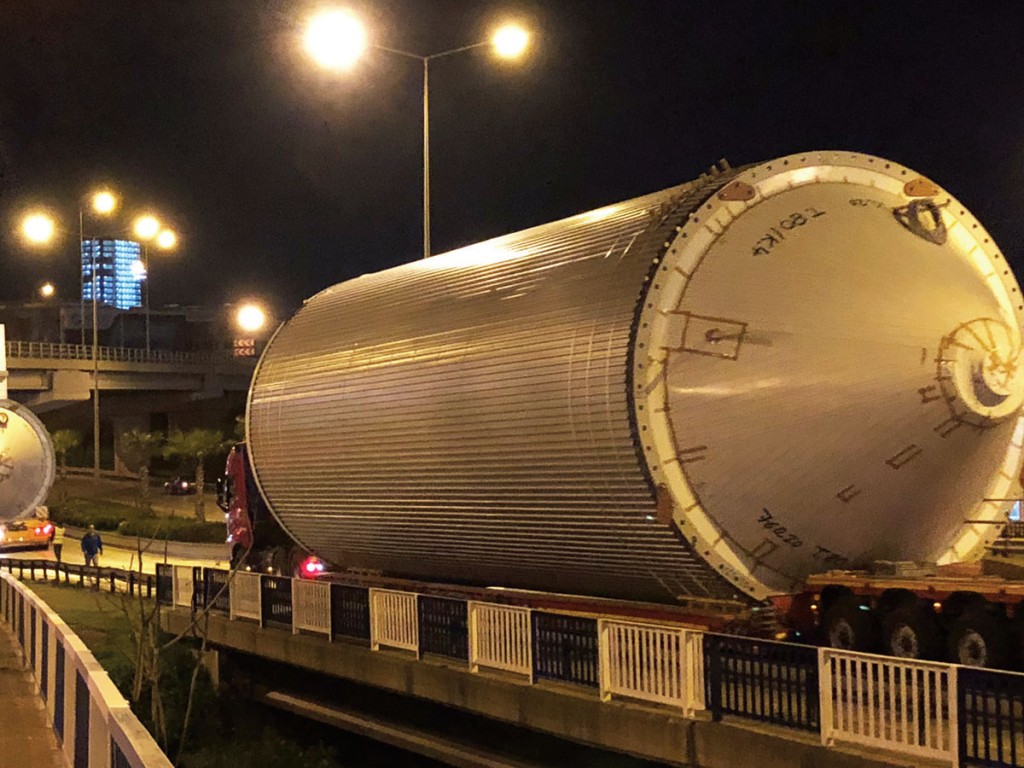
The 18-kilometers journey had all the usual pitfalls and challenges, like squeezing through crowded neighborhoods, removing overhead street signs, protecting CCTVs, working with the local police and coordinating with the electric company to cut power along the route. But in this case, the logistics team had no choice but to pass along a road lined with dozens of bars and discos on both sides. Because of traffic considerations, this operation had to be done in the middle of six consecutive nights, which meant no power for two hours a night. That meant revelers flocked outside, trading loud music and dancing, for alcohol-infused rubbernecking.
“You’re dealing with all the bar owners, drunk people all around,” said Bahadir Erdil, Logistic Plus’s global projects director, as well as the managing director of the company’s Turkey operations. “It was horrifying. It was very stressful. It was also very funny.”
He then related the story about how one night a young woman came up to them with an empty glass, asking for beer, believing the tanks were full.
“I told my team, ‘with this operation, you’re having a masters’ degree in logistics, because you have everything in it,’” said Erdil.
A Heavy Lift SWAT Team
The company has nicknamed that kind of team “special projects operations and tactics,” or “SPOT.” It is likened to a project cargo or heavy-lift SWAT team. It’s one of the strengths of Logistics Plus, based in the old Union Station in Erie, PA. The company is a mid-sized 3PL, with 500 plus employees located in more than 20 countries. But a particular focus on heavy lift logistics started early on. It was founded in 1996 and its first big client was GE Transportation, the locomotive manufacturer, which merged last year with Wabtec Corp.
Logistics Plus now has dedicated project cargo teams that, the company believes, is critical in attracting and successfully completing heavy-lift operations assignments around the world. The teams are individually tethered to one country or region, but collectively global in scope and reach.
With a traditional dependence on energy-related plant and equipment, the heavy-lift, project cargo market has seen its fortunes rise and fall over time. When oil prices fell in 2016, so, too, did the project cargo market. More recent trade tensions haven’t helped, either.
However, that project cargo marketplace is diversifying, expanding geographically and becoming increasingly complex. Think wind-related power, for example, and the difficulties of moving blades that can eclipse 100 meters each in treacherous waters.
Heavy lift cargo is becoming heavier, as pieces of equipment grow in size. A single power transformer now can weigh upwards of 500 tons.
Project cargo is getting more complicated, more challenging and just more expensive. Some of the biggest construction projects — say a mammoth petrochemical plant — can have logistics costs in the hundreds of millions of dollars.
Accurately predicting transport costs can sometimes spell the difference between profit and ruin. “If we calculate something wrong, it would be a disaster” for the manufacturer, said Erdil.

Heavy lift cargo demands brain as well as brawn. “Project logistics is not only a transportation operation from location A to B,” Erdil. “It consists of lots of engineering planning.”
Multinational Nature of Project Moves
Project cargo is also becoming more and more multinational in nature. It’s increasingly commonplace to build in one country and then transport and deliver to another. That means the project cargo logistics provider must bridge borders as well as squeeze under bridges. So, detailed knowledge of local regulations and terrain is as fundamental as the skills necessary to transport the cargo itself. Bahadir calls these “regional experts.”
Giant projects demand years of forward planning. Project cargo specialists are called in at the very early stages of manufacturing, often shortly after the equipment provider has a contract. That’s sometimes as much as three years before the actual transportation. “There is a long planning process behind it,” Erdil said.

Erdil cited as an example last year’s transport of platforms used in shiplift and transfer systems from Iskenderun, Turkey, where they were manufactured, to Shuaiba, Kuwait. The manufacturer turned to Logistics Plus to not only plan the transport of these three platforms, which totaled 4,000 freight tons, but also where they could be manufactured. The client’s existing factory simply wasn’t big enough. So, Logistics Plus was called in to analyze where the platforms could be manufactured, in tandem with an optimum location for transportation, as well as the actual freight costs.
“We found some shipyards, we found some ports where our client could manufacture their products, so they could be transportable at the end of the day,” Erdil said.
Erdil, himself, grew up in Turkey, but is now based in Houston. That’s provided an unexpected outlet for his other passion — basketball. A talented youth player who also played amateur basketball in his 20s, Erdil was tapped by a friend to write about the Houston Rockets for TrendBasket, a Turkish sports magazine. Erdil, 35, is now an accredited NBA journalist.
Follow us on social media: